Articles
2 Min Read
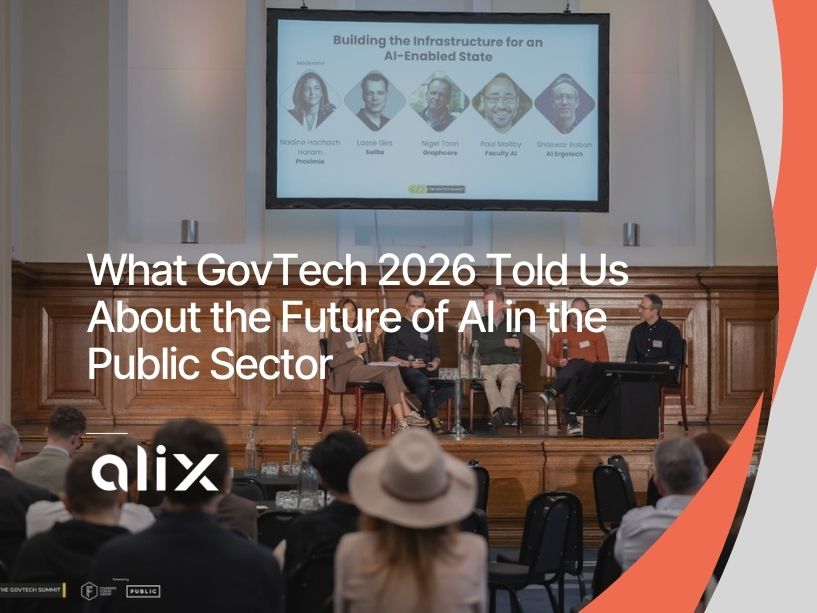
Last week I attended GovTech 2026, one of the more energising events on the public sector calendar. The conversations ranged from quantum computing timelines to Ukraine's digital transformation story, but several themes kept surfacing that felt directly relevant to what we're doing at Alix and to the wider challenge of getting technology to actually work for people in public services.
Here's what stayed with me.
The pilot trap is real, and everyone knows it
There's a phrase that should be retired from every public sector tech conversation: "we're running a pilot." Not because pilots are bad, but because in too many organisations, pilots have become a destination rather than a starting point. The Government Digital Service made the point plainly: the UK has genuine in-house AI talent, possibly among the strongest in the world alongside Singapore, and the Chief AI Office and incubator teams are well set up. The bottleneck isn't capability. It's the leap from proof of concept to scaled deployment.
This is not a new observation, but it was striking to hear it named so directly at a government technology conference. The conditions that make a pilot succeed, small teams, clear mandates, protected budgets, tend to be precisely the conditions that don't survive contact with wider organisational reality. Solving that is less a technology problem than a leadership and governance one.
Procurement is still the biggest barrier nobody wants to fix
If there was one topic that generated genuine heat in the room, it was procurement. The numbers are difficult to argue with: sales cycles of 18 to 24 months are standard, sometimes stretching to three or four years. The Big Four consulting firms take roughly 80% of contract value while smaller specialist firms do the majority of the actual delivery work. And approval processes involving 30 or more stakeholders are not unusual.
For a startup trying to bring genuinely innovative technology into the public sector, this is not a minor inconvenience. It's a structural barrier that favours incumbents and penalises the kinds of organisations most likely to have built something genuinely new.
The proposed solutions on the table, two-stage tender procedures with demo days, procurement standards that surface SME barriers automatically, a sharper focus on outcomes over process, are sensible. Whether there's political will to implement them at scale is a different question. What was encouraging was the level of consensus in the room that the current system is failing the sector it's supposed to serve.
Trust is both the goal and the risk
One of the more striking data points from the day: 85% of users reportedly trust government AI responses without checking them. Gov.uk is, by any measure, an extraordinarily trusted brand. That trust has been built over decades of reliable, accessible public service delivery. It is not guaranteed to survive poor AI implementation.
This matters for anyone working in public sector technology. The standard for "good enough" is higher here than in commercial contexts, not lower. Members of the public interacting with AI-assisted government services are not choosing between products. They are, in many cases, accessing something they have no alternative to. Getting it wrong has consequences that go beyond brand damage.
The conversation around transparency was particularly interesting. It's not enough for AI systems to be technically explainable. Transparency of intent, why a system was built the way it was, what trade-offs were made, who it was designed to serve, is becoming as important as transparency of action.
The Thames Freeport healthcare model is worth studying
One case study that deserved more attention than it got was the Thames Freeport AI healthcare programme. A £3.5 million investment spanning primary care, community prevention, and complex care, with four-month deployment cycles, co-design with end users, and rigorous supplier vetting. Seven hundred patients seen through a mobile screening unit. Over 250 healthcare staff trained.
What made this feel different from the pilot trap described above was the deployment rhythm. Four months to go live is a discipline that forces prioritisation and prevents scope creep. It's worth asking, in social housing as much as in healthcare, how often long procurement and delivery timelines are a proxy for unclear thinking about what's actually needed.
What this means for social housing
Alix sits at an interesting intersection of everything that was discussed at GovTech. We operate in a sector where procurement culture shares many of the same risk-averse characteristics as central government. Where the gap between knowing AI can help and actually deploying it at scale is very real. Where trust, specifically the trust tenants place in their landlord, is both essential and fragile.
The organisations that will lead in this environment are not necessarily the ones with the largest technology budgets. They're the ones willing to move at the speed of the problem, to demand outcomes rather than processes from their technology partners, and to take seriously the question of what it means to deploy AI responsibly in services that people depend on.
That's the work. GovTech 2026 confirmed we're not the only ones thinking about it.