Startup Founders Meet UCL Impact Investors: Workshop Lessons on Scaling Social Impact
Press Release
Feb 4, 2024
2/4/24
5 Min Read
Discover what happens when Project Alix startup founders meet impact investors. Insights from a UCL Responsible Finance workshop with Better Society Capital on scaling social ventures.


Bridging Startup Strategy and Portfolio Thinking: Lessons from UCL's Responsible Finance Module
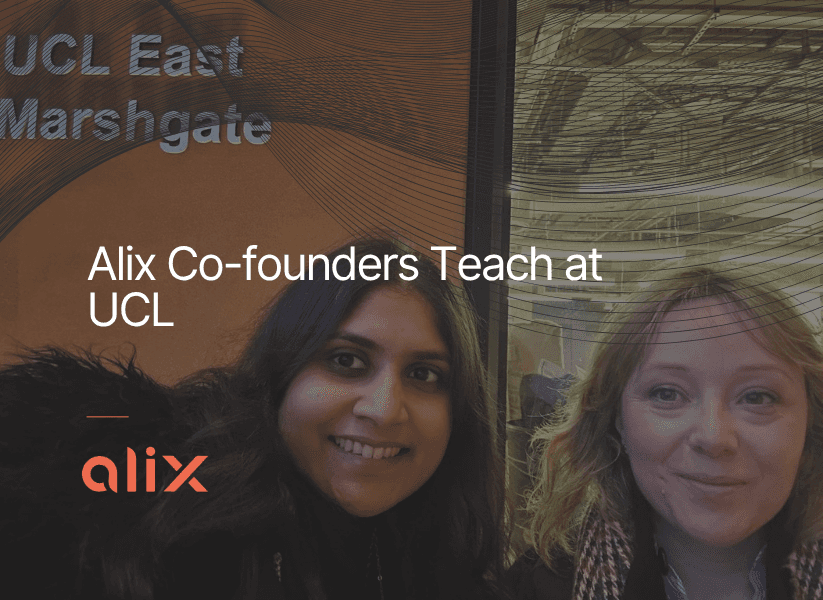
One of entrepreneurship's greatest gifts is variety—the constant exposure to new perspectives, challenges, and opportunities that keep the work dynamic and engaging. A perfect example of this was when Charisma Mehta and I had the privilege of running a startup strategy workshop with students from UCL's Responsible Finance and Alternative Assets MSc program.
The session, organized as part of a module led by Jeremy Rogers and Rebecca MacDonald from Better Society Capital, proved to be a refreshing exchange of ideas that bridged two often-separate worlds: the fast-paced, ground-level reality of startups and the strategic, systems-level thinking of institutional impact investors.
A Meeting of Mindsets
As founders of Project Alix, we operate in a space where change happens rapidly and resources are carefully managed. Our reach, while growing, remains focused and deliberate. Stepping into a room with students who are learning to think through a portfolio lens—considering how to deploy capital across multiple ventures and initiatives—offered a fascinating contrast.
The workshop brought together diverse perspectives on creating social impact at scale. We heard about Better Society Capital's impressive work in establishing over £3 billion of social impact investment across more than 200 institutional investors, supporting over 3,500 charities and social enterprises tackling critical issues like homelessness and fuel poverty. Paul Kirby from Zinc VC, one of Alix's investors, shared insights on their unique approach to building big, impactful ventures from the ground up. Students also presented inspiring projects from around the globe, each grappling with the challenge of scaling social innovation.
Learning Goes Both Ways
What made the workshop particularly valuable was the bidirectional nature of the learning. While we shared our experiences navigating the realities of startup strategy—the pivots, the resource constraints, the constant balancing act between vision and execution—the students brought fresh thinking about how to scale impact ventures. Their ideas about growth strategies weren't just theoretical; they were informed by exposure to world-class practitioners who understand both the financial mechanisms and the social outcomes that matter.
Jeremy Rogers and Rebecca MacDonald, both Industrial Professors at UCL, bring remarkable depth to their teaching. Jeremy's 25-plus years across charitable and investment sectors, including his role as Chief Investment Officer at Better Society Capital, combined with Rebecca's trilingual approach spanning financial, public, and third sectors, creates a rich learning environment. Rebecca's work as Founding Chair of the world's first professional qualification in impact investing through CFA UK demonstrates the kind of systems-level thinking these students are absorbing.
The Power of Portfolio Perspective
For those of us in the trenches of building individual ventures, there's immense value in understanding how portfolio investors think. They see patterns across multiple organizations, identify what works at scale, and understand the infrastructure needed to support sustainable impact. This perspective challenges startups to think beyond survival mode and consider how their solutions might fit into larger ecosystems of change.
At the same time, portfolio thinkers benefit from understanding the entrepreneurial reality—the human stories, the on-the-ground challenges, and the creative problem-solving that happens when resources are limited but commitment is unlimited.
Building Bridges for Greater Impact
As the impact investing field matures, these kinds of exchanges become increasingly crucial. The students in UCL's Responsible Finance program represent the next generation of leaders who will bridge capital and impact, strategy and execution, theory and practice. Their ability to understand both startup dynamics and portfolio strategy positions them to be more effective in whatever roles they choose—whether as investors, founders, advisors, or policymakers.
For Project Alix, workshops like this remind us that while our daily work may be focused on immediate challenges, we're part of a larger movement toward more responsible, impactful approaches to finance and social innovation. The variety inherent in entrepreneurship isn't just about the work itself—it's about the connections we make and the perspectives we gain along the way.
The future of impact depends on these conversations continuing, on these bridges being built and strengthened between those making change happen on the ground and those enabling it from above.
Bridging Startup Strategy and Portfolio Thinking: Lessons from UCL's Responsible Finance Module
One of entrepreneurship's greatest gifts is variety—the constant exposure to new perspectives, challenges, and opportunities that keep the work dynamic and engaging. A perfect example of this was when Charisma Mehta and I had the privilege of running a startup strategy workshop with students from UCL's Responsible Finance and Alternative Assets MSc program.
The session, organized as part of a module led by Jeremy Rogers and Rebecca MacDonald from Better Society Capital, proved to be a refreshing exchange of ideas that bridged two often-separate worlds: the fast-paced, ground-level reality of startups and the strategic, systems-level thinking of institutional impact investors.
A Meeting of Mindsets
As founders of Project Alix, we operate in a space where change happens rapidly and resources are carefully managed. Our reach, while growing, remains focused and deliberate. Stepping into a room with students who are learning to think through a portfolio lens—considering how to deploy capital across multiple ventures and initiatives—offered a fascinating contrast.
The workshop brought together diverse perspectives on creating social impact at scale. We heard about Better Society Capital's impressive work in establishing over £3 billion of social impact investment across more than 200 institutional investors, supporting over 3,500 charities and social enterprises tackling critical issues like homelessness and fuel poverty. Paul Kirby from Zinc VC, one of Alix's investors, shared insights on their unique approach to building big, impactful ventures from the ground up. Students also presented inspiring projects from around the globe, each grappling with the challenge of scaling social innovation.
Learning Goes Both Ways
What made the workshop particularly valuable was the bidirectional nature of the learning. While we shared our experiences navigating the realities of startup strategy—the pivots, the resource constraints, the constant balancing act between vision and execution—the students brought fresh thinking about how to scale impact ventures. Their ideas about growth strategies weren't just theoretical; they were informed by exposure to world-class practitioners who understand both the financial mechanisms and the social outcomes that matter.
Jeremy Rogers and Rebecca MacDonald, both Industrial Professors at UCL, bring remarkable depth to their teaching. Jeremy's 25-plus years across charitable and investment sectors, including his role as Chief Investment Officer at Better Society Capital, combined with Rebecca's trilingual approach spanning financial, public, and third sectors, creates a rich learning environment. Rebecca's work as Founding Chair of the world's first professional qualification in impact investing through CFA UK demonstrates the kind of systems-level thinking these students are absorbing.
The Power of Portfolio Perspective
For those of us in the trenches of building individual ventures, there's immense value in understanding how portfolio investors think. They see patterns across multiple organizations, identify what works at scale, and understand the infrastructure needed to support sustainable impact. This perspective challenges startups to think beyond survival mode and consider how their solutions might fit into larger ecosystems of change.
At the same time, portfolio thinkers benefit from understanding the entrepreneurial reality—the human stories, the on-the-ground challenges, and the creative problem-solving that happens when resources are limited but commitment is unlimited.
Building Bridges for Greater Impact
As the impact investing field matures, these kinds of exchanges become increasingly crucial. The students in UCL's Responsible Finance program represent the next generation of leaders who will bridge capital and impact, strategy and execution, theory and practice. Their ability to understand both startup dynamics and portfolio strategy positions them to be more effective in whatever roles they choose—whether as investors, founders, advisors, or policymakers.
For Project Alix, workshops like this remind us that while our daily work may be focused on immediate challenges, we're part of a larger movement toward more responsible, impactful approaches to finance and social innovation. The variety inherent in entrepreneurship isn't just about the work itself—it's about the connections we make and the perspectives we gain along the way.
The future of impact depends on these conversations continuing, on these bridges being built and strengthened between those making change happen on the ground and those enabling it from above.
Bridging Startup Strategy and Portfolio Thinking: Lessons from UCL's Responsible Finance Module
One of entrepreneurship's greatest gifts is variety—the constant exposure to new perspectives, challenges, and opportunities that keep the work dynamic and engaging. A perfect example of this was when Charisma Mehta and I had the privilege of running a startup strategy workshop with students from UCL's Responsible Finance and Alternative Assets MSc program.
The session, organized as part of a module led by Jeremy Rogers and Rebecca MacDonald from Better Society Capital, proved to be a refreshing exchange of ideas that bridged two often-separate worlds: the fast-paced, ground-level reality of startups and the strategic, systems-level thinking of institutional impact investors.
A Meeting of Mindsets
As founders of Project Alix, we operate in a space where change happens rapidly and resources are carefully managed. Our reach, while growing, remains focused and deliberate. Stepping into a room with students who are learning to think through a portfolio lens—considering how to deploy capital across multiple ventures and initiatives—offered a fascinating contrast.
The workshop brought together diverse perspectives on creating social impact at scale. We heard about Better Society Capital's impressive work in establishing over £3 billion of social impact investment across more than 200 institutional investors, supporting over 3,500 charities and social enterprises tackling critical issues like homelessness and fuel poverty. Paul Kirby from Zinc VC, one of Alix's investors, shared insights on their unique approach to building big, impactful ventures from the ground up. Students also presented inspiring projects from around the globe, each grappling with the challenge of scaling social innovation.
Learning Goes Both Ways
What made the workshop particularly valuable was the bidirectional nature of the learning. While we shared our experiences navigating the realities of startup strategy—the pivots, the resource constraints, the constant balancing act between vision and execution—the students brought fresh thinking about how to scale impact ventures. Their ideas about growth strategies weren't just theoretical; they were informed by exposure to world-class practitioners who understand both the financial mechanisms and the social outcomes that matter.
Jeremy Rogers and Rebecca MacDonald, both Industrial Professors at UCL, bring remarkable depth to their teaching. Jeremy's 25-plus years across charitable and investment sectors, including his role as Chief Investment Officer at Better Society Capital, combined with Rebecca's trilingual approach spanning financial, public, and third sectors, creates a rich learning environment. Rebecca's work as Founding Chair of the world's first professional qualification in impact investing through CFA UK demonstrates the kind of systems-level thinking these students are absorbing.
The Power of Portfolio Perspective
For those of us in the trenches of building individual ventures, there's immense value in understanding how portfolio investors think. They see patterns across multiple organizations, identify what works at scale, and understand the infrastructure needed to support sustainable impact. This perspective challenges startups to think beyond survival mode and consider how their solutions might fit into larger ecosystems of change.
At the same time, portfolio thinkers benefit from understanding the entrepreneurial reality—the human stories, the on-the-ground challenges, and the creative problem-solving that happens when resources are limited but commitment is unlimited.
Building Bridges for Greater Impact
As the impact investing field matures, these kinds of exchanges become increasingly crucial. The students in UCL's Responsible Finance program represent the next generation of leaders who will bridge capital and impact, strategy and execution, theory and practice. Their ability to understand both startup dynamics and portfolio strategy positions them to be more effective in whatever roles they choose—whether as investors, founders, advisors, or policymakers.
For Project Alix, workshops like this remind us that while our daily work may be focused on immediate challenges, we're part of a larger movement toward more responsible, impactful approaches to finance and social innovation. The variety inherent in entrepreneurship isn't just about the work itself—it's about the connections we make and the perspectives we gain along the way.
The future of impact depends on these conversations continuing, on these bridges being built and strengthened between those making change happen on the ground and those enabling it from above.